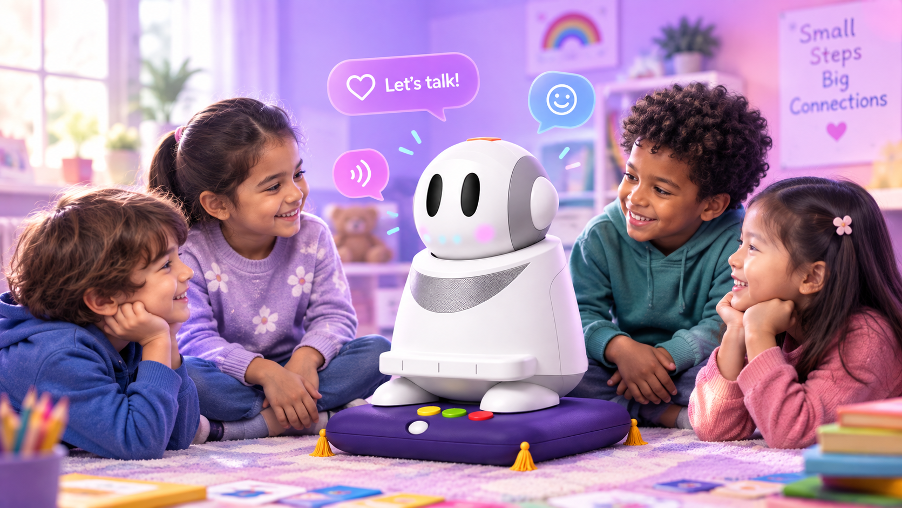

Many autistic children experience social interaction as intense: faces move quickly, tone changes, and responses can be unpredictable. Even when a child wants to connect, the sensory and cognitive load can be exhausting.
Social robots can reduce that load by creating a more predictable practice space. They can be especially useful when a child:
Important: social robots work best as a bridge-supporting the child to practise skills that are later generalised to real people (family, educators, peers). They should never replace human relationships or clinical care.
Support type Best for Limitations to plan for AAC (apps, devices, PECS) Expressing needs, building language, participation across settings Requires consistent modelling; device access; team training Social robots Low-pressure practice for social communication, emotions, turn-taking, routines Must be integrated with real-world practice; needs supervision and goal alignment Speech therapy / allied health Assessment, personalised goals, skill building, generalisation planning Time and funding constraints; progress depends on practice between sessions
Matilda is an AI-powered companion robot designed to enrich daily life through meaningful conversation, cognitive engagement, and emotionally supportive interaction. In autism support settings, the goal isn’t to “automate” therapy-it’s to create more high-quality practice moments, while empowering parents, educators, and clinicians to spend their time where it matters most: human connection.
Joint attention is a foundational skill for social communication. A robot can support joint attention through guided prompts-inviting the child to look, point, match, and share attention in a structured way that can feel less confronting than face-to-face interaction.
Turn-taking is more than waiting-it’s reading timing, staying regulated, and understanding that communication is two-way. Robot-led activities can provide clear “your turn / my turn” cues and gentle prompts to help children practise this rhythm.
Many children benefit from explicit teaching of emotions and social cues. With simplified, consistent facial expressions and scenario-based activities, a robot can help children practise:
In speech therapy autism programs, progress often relies on repeated practice. Social robots can support speech and language practice by offering patient repetition and encouraging prompts-helping children feel safe to attempt sounds, words, or short phrases.
In classrooms, clinics, and family homes, consistency is hard-especially when staff are stretched or families are juggling multiple responsibilities. A companion robot can help maintain a steady routine of practice activities, while professionals focus on planning, coaching, and meaningful interaction.